
Over the past three years, I have been fortunate to serve as Founder and Co-Convenor of the Malusog at Matalinong Bata Coalition (Smart & Healthy Kids Coalition) in the Philippines.
Together with government champions, we designed the government’s First 1,000 Days conditional cash grant. Launched in February 2025, the program is helping 192,981 pregnant women and children in poor families afford food and develop healthy habits to prevent malnutrition.
We are currently working with the Philippines’ national health insurance agency to secure stable financing and establish clear incentives for the health system to routinely monitor children and deliver essential nutrition interventions.
Read more on this OpEd: https://opinion.inquirer.net/187986/stunting-if-feeding-doesnt-work-what-might
Why am I working on malnutrition?
The sad reality: 1 in 4 children around the world are chronically undernourished.

Source: UNICEF, World Bank, WHO Joint Child Malnutrition Estimates
Child malnutrition has lifelong, irreversible consequences on brain capacity, educational attainment, health in adulthood, and ability to escape poverty.
A huge portion of brain growth occurs by age two: a fragile period when nutrition, care, and stimulation shape lifelong development. The medical literature shows that undernutrition over a child’s first 1,000 days (from conception to two years old) leads to irreversible damage into adulthood.
Early deprivation yields not just small bodies but underdeveloped brains: stunting brings reduced cognition, learning difficulties, lower school and work potential, and higher likelihood of poverty.
Undernutrition traps generations, too. A mother who was chronically malnourished as a child is likelier to bear a low birthweight child, repeating the vicious cycle.
Sources: 2008 and 2013 Lancet Series on maternal and child undernutrition, Harvard University Centre on the Developing Child
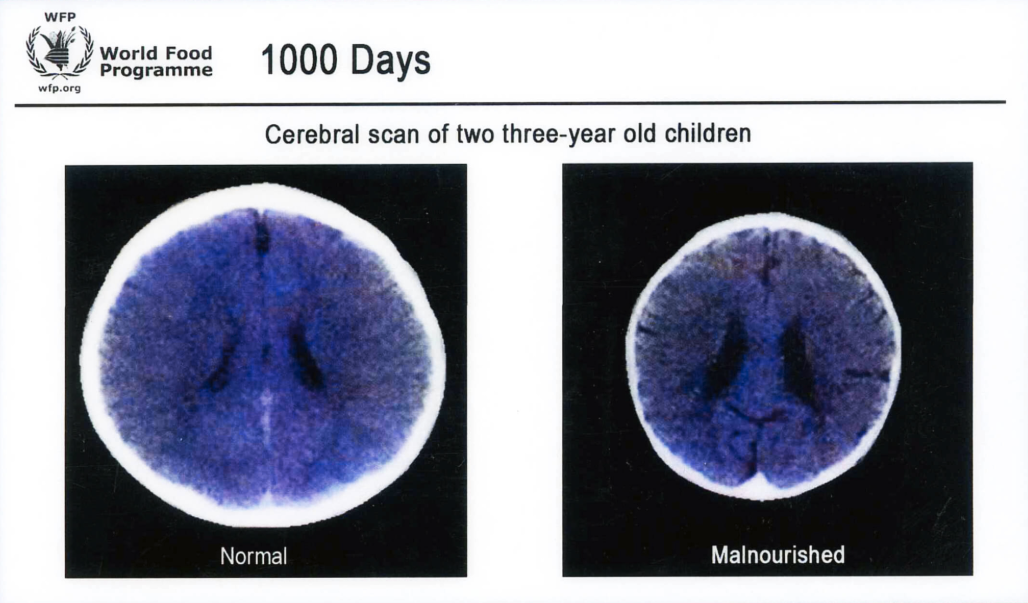
Photo: UN World Food Programme
The good news: many proven solutions exist to beat undernutrition.
Thanks to the efforts of the medical community, development workers, governments, and economists worldwide, we now understand what can break the cycle of malnutrition. Preventing it requires early, sustained intervention to achieve:
adequate maternal nutrition before, during, and after pregnancy;
promotion and support of breastfeeding, appropriate complementary infant feeding, and timely micronutrient supplementation
good health and sanitation, including vaccination, deworming, oral care, and infection prevention;
regular growth monitoring and prompt treatment when needed; and
responsive caregiving with stimulation through play, conversation, and nurturing interactions with children.

Photo: UNICEF Philippines
The challenge ahead: most countries struggle to fund and scale these interventions consistently and systemically.
The economic returns to investing in nutrition are substantial, yet many countries still underinvest. Key barriers include:
Weak political commitment and limited managerial focus. Nutrition often lacks high-level champions and is sidelined amid competing priorities.
Targeting challenges. Identifying pregnant women and young children is difficult where civil and health records are incomplete and service delivery is weak . This is one of the challenges we face in the Philippines!
Inadequate or misallocated resources. Budgets are too small, or funds are spent on low-impact interventions rather than proven, cost‑effective measures.
Fragmented delivery. Programs that are ad hoc, donor-driven, or poorly coordinated fail to leverage existing systems and scale sustainably.
In the Philippines, our coalition seeks to tackle these barriers by working through the government to scale and systematize evidence-based interventions.
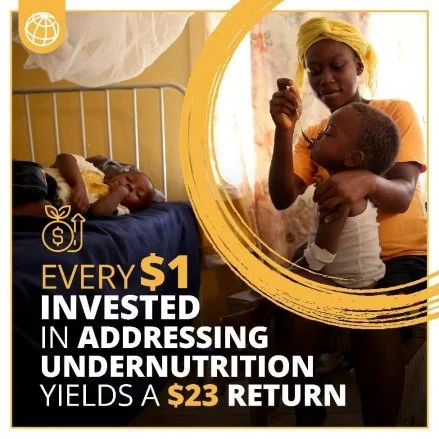
Photo: World Bank
More resources
For more about the Malusog at Matalinong Bata Coalition (Smart & Healthy Kids Coalition), see:
Our Facebook page
Our latest thinking on malnutrition in the Philippines
In my opinion, the best recent systemic review of undernutrition in the Philippines from the World Bank
For malnutrition in general, see:
The latest global data on malnutrition
2008 and 2013 Lancet series on maternal and child undernutrition
This practical class on cooking healthy food for your tiny loved ones from the Stanford School of Medicine Online
Terminologies: On this page, we’ve used malnutrition and undernutrition interchangeably, but technically malnutrition covers a broader range of issues, including overnutrition (i.e., obesity and overweight). This is a rising problem in most developed and some developing countries. Chronic undernutrition is measured by stunting (low height-for-age).
To wrap up this section, check out this documentary featuring an interview with me!